How to Choose the Best Hazard Warning Signs for Your Workplace
Why Hazard Warning Signs Are a Legal and Practical Necessity
Hazard warning signs exist to do one job well: communicate a risk instantly, without relying on language or training in the moment. For UK employers, they're also a legal requirement in specific circumstances. Under the Health and Safety (Safety Signs and Signals) Regulations 1996, employers must provide and maintain safety signs wherever a significant risk remains after all other reasonably practicable control measures have been put in place — in other words, signage is the backstop, not a substitute for eliminating or reducing the hazard itself.Beyond the legal minimum, good signage genuinely reduces incidents. A clearly visible, well-placed sign gives visitors, contractors and new starters — the people least familiar with a site's specific risks — an instant, unambiguous warning that even the best induction training can't fully replace.
The Sign Categories You Need to Know
UK safety signs follow a standardised shape-and-colour system, so their meaning is recognisable even before the pictogram is read:
Prohibition signs — round, red border with a white background and black pictogram, used to indicate an action that must not be taken.
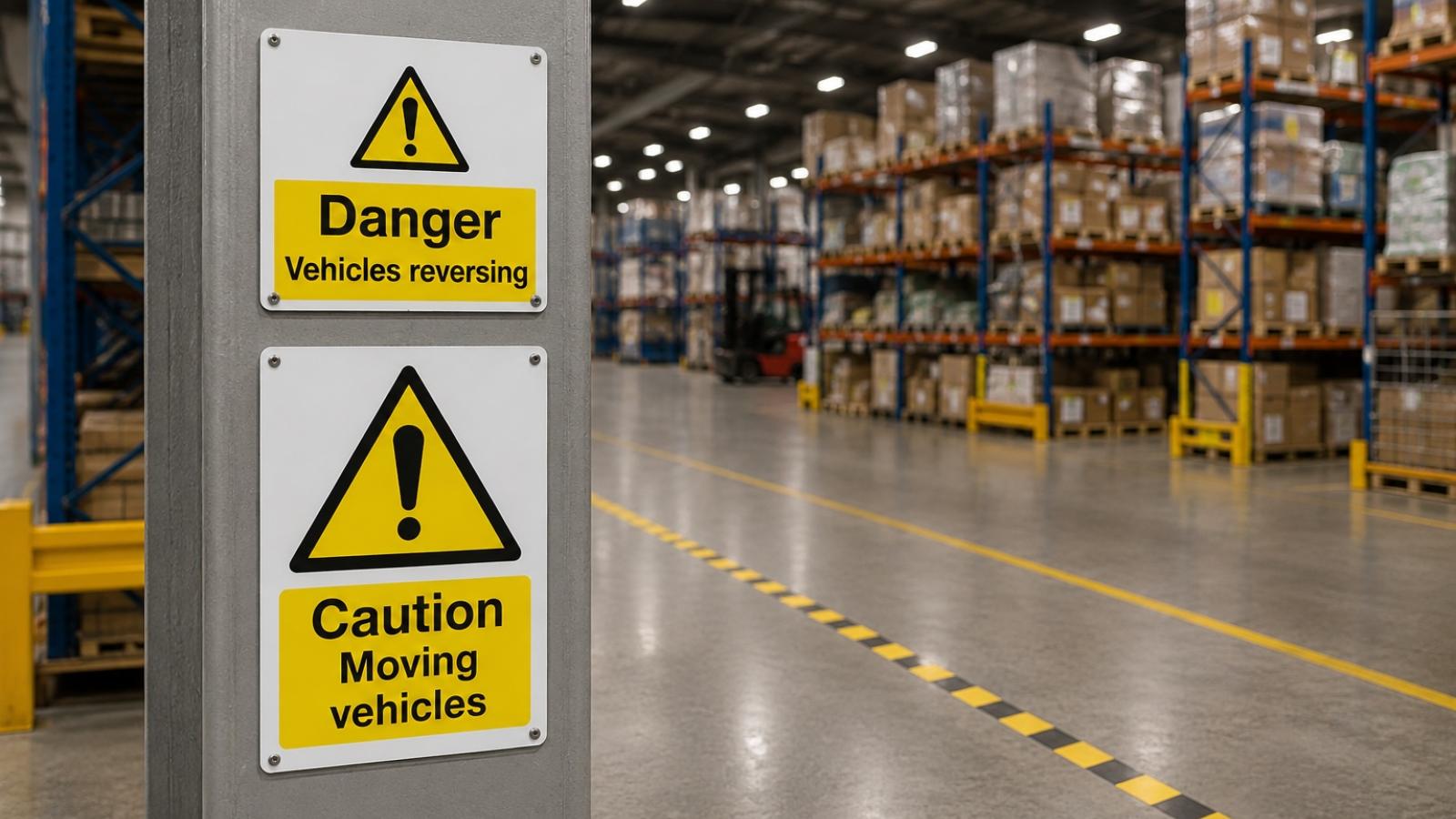
Warning signs — yellow triangle with a black border and black pictogram, used to flag a hazard such as a slip risk, electrical danger or moving vehicles.
Mandatory signs — round, blue background with a white pictogram, used to instruct a specific action such as wearing PPE.
Safe condition and emergency signs — green rectangle or square with a white pictogram, used for escape routes, first aid points and emergency equipment.
Fire equipment signs — red rectangle or square with a white pictogram, used to mark fire extinguishers, alarm points and fire-fighting equipment.
What UK Law Requires
The Health and Safety (Safety Signs and Signals) Regulations 1996 set out the shapes, colours and pictograms that safety signs must follow, and require that signs are provided where a workplace risk assessment identifies a risk that can't be avoided or adequately controlled by other means. Fire safety signs are also required separately under fire safety legislation. Employers additionally have a duty to make sure employees understand the meaning of the signs used on site and are trained accordingly — a sign that nobody understands offers little real protection.In practice, this means signage decisions should follow directly from a documented risk assessment, rather than being chosen generically — the signs on site should map to the specific hazards that assessment identifies.
How to Choose the Right Signs for Your Workplace
Start from the risk assessment — identify exactly which hazards remain after other controls are in place, and select signs that match them, rather than adding signage generically.
Prioritise the pictogram — UK regulations require the symbol to carry the core meaning, with any text used only as a supplementary plate rather than a replacement.
Choose the right material for the environment — rigid PVC or aluminium for outdoor and high-wear areas, self-adhesive vinyl for indoor surfaces, and photoluminescent options where emergency visibility in low light matters.
Size for the viewing distance — a sign that's perfectly legible up close can be effectively invisible from twenty metres away in a large warehouse or yard.
Placement and Maintenance Best Practice
Position signs at eye level, well lit, and free from obstruction by racking, stock or equipment.
Avoid clustering too many signs in one place — overloading an area with signage reduces the impact of each individual warning.
Inspect signs on a regular schedule and replace any that have faded, been damaged or become obscured, since a sign that can no longer be read clearly no longer meets its purpose.
Review signage whenever a process, layout or piece of equipment changes, rather than only at fixed intervals.
Directa's Hazard Sign Range
Directa supplies a full range of hazard, prohibition, mandatory and fire safety signage in rigid and self-adhesive formats, suited to warehouses, yards, factories and public-facing sites. If you're updating signage following a risk assessment or fitting out a new site, our team can help you specify the right signs for the job.